
Two years ago, I started doing something most people would tell you is a bad idea.
I increased my intake of saturated fats. Coconut oil, butter, animal fats…all of it.
And instead of things getting worse, I lost 19 kilos.
My HDL, the so-called “good cholesterol”, went from 18% to 29%. My triglycerides dropped, which is a major marker of metabolic health when elevated. My visceral fat came down significantly. But more importantly than any number, my health changed completely.
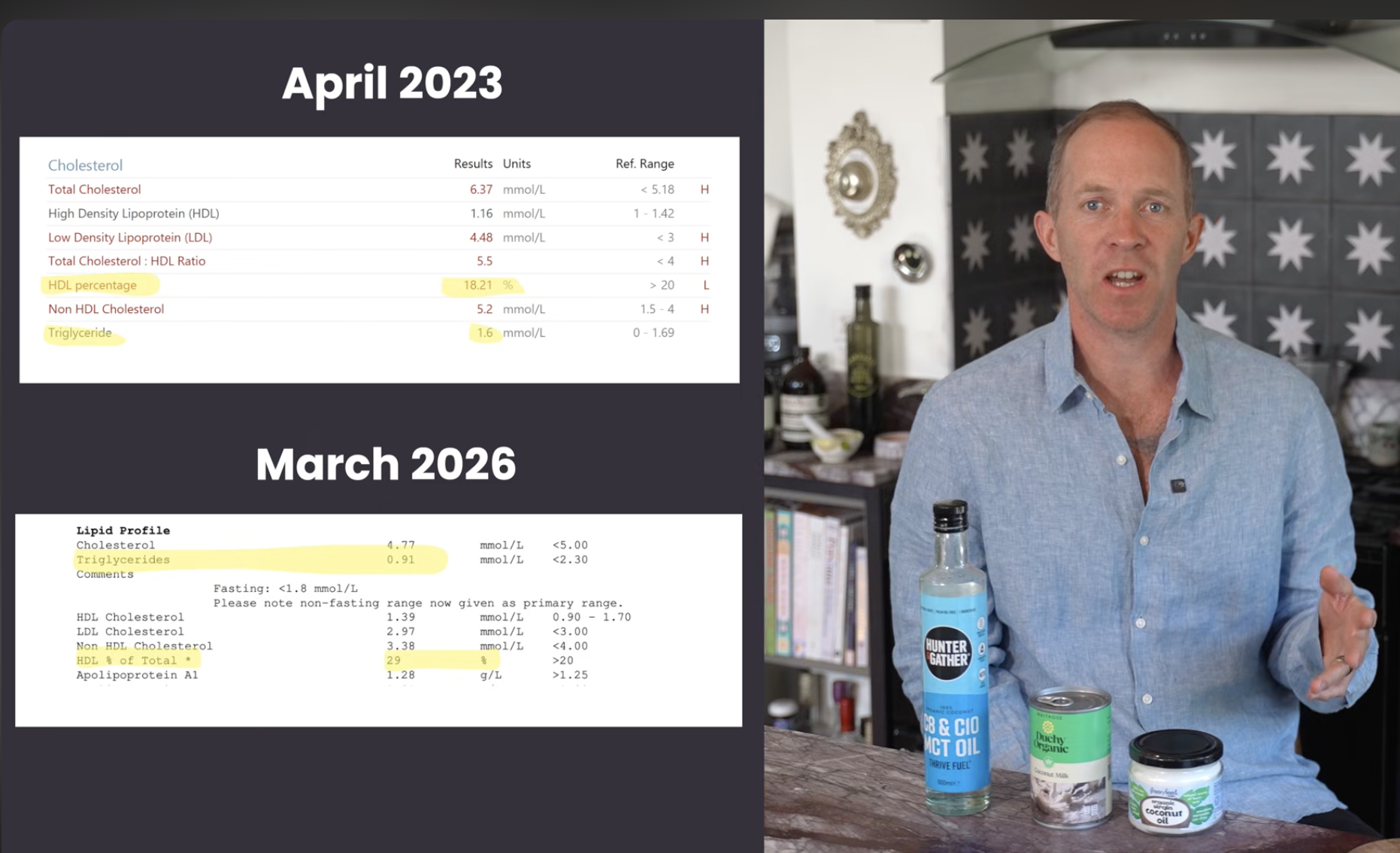
After more than twenty years dealing with colitis, autoimmune issues, and asthma…my symptoms disappeared.
So the question is, why are we still being told coconut oil is bad for us?
The Problem With What We’re Told
If you go online right now, you’ll still find content from major institutions suggesting coconut oil is harmful. The common claims are that it raises “bad cholesterol,” contributes to heart disease, and should be avoided.
But when you look closer, something important is often missing, and that is context.
In many cases, the studies or sources behind these claims aren’t clearly explained. And when we talk about cholesterol, the conversation is rarely as simple as “good” versus “bad.”
LDL on its own doesn’t tell the full story. Factors like particle size, oxidation, triglycerides, and HDL ratios all play a role in understanding actual risk. When you start digging into more recent research, the picture becomes far less clear-cut than the headlines suggest.
The Narrative vs Reality
The mainstream narrative is still simple: saturated fat equals heart disease, and coconut oil equals a bad fat.
But when you look deeper, things don’t quite add up.
Yes, coconut oil is around 90% saturated fat. That sounds alarming at first. But what’s rarely explained is that a large portion of this fat comes from medium-chain triglycerides, or MCTs.
These fats behave very differently in the body. Instead of being slowly digested and stored, MCTs are sent straight to the liver where they’re rapidly used for energy. They can also be converted into ketones and are less likely to be stored as body fat.
Most fats take the slow road through the body. MCTs take the fast lane straight to energy.
Coconut oil also contains lauric acid, which has antimicrobial properties and may support the immune system. Another aspect that’s often overlooked.
The Flaw in the Research
One of the biggest issues in nutrition research is how studies are designed.
Take a commonly referenced trial where participants were told to consume around 50 grams of fat per day, either adding coconut oil or replacing it with other fats. What’s often not controlled is the rest of their diet.
There’s usually no strict control over sugar intake, processed foods, or overall meal composition.
So in reality, someone in that study could have been adding coconut oil to a diet already high in refined carbs and ultra-processed foods. They could be cooking with it while still eating cereal, pasta, and snacks loaded with sugar.
That changes everything.
Fat behaves very differently depending on the environment it’s consumed in. A high-fat, high-sugar, high-carb diet creates a completely different metabolic state compared to a whole-food, lower-insulin approach.
So the real question becomes: are we testing coconut oil, or are we testing coconut oil on top of a poor diet?
What the Research Actually Shows
When you look across the research as a whole, it’s far from one-sided.
Some studies show coconut oil can increase LDL, but they also show increases in HDL. Context matters.
Other research suggests that virgin coconut oil may reduce LDL oxidation, which is important because oxidised LDL is considered more harmful than LDL alone.
It’s also worth looking at traditional diets. In regions like Southeast Asia and the Pacific, coconut has been a staple fat for generations. Historically, these populations didn’t experience the same levels of metabolic disease we see today.
So we’re left with conflicting modern studies, strong traditional use, and a growing number of real-world experiences that don’t always match the narrative.
So Where Does That Leave Us?
From my own experience, and from what I’ve seen in others, coconut oil isn’t the villain it’s often made out to be.
When used in the right context, within a whole-food, lower-sugar, minimally processed diet, it can be incredibly supportive. We’re talking about improved HDL levels, better triglyceride balance, more stable energy, and even antimicrobial support.
For me personally, after two years of including saturated fats like coconut oil, my HDL improved, my triglycerides dropped, and my inflammation disappeared.
Of course, part of that likely came from removing ultra-processed foods and excess sugar. But when you combine that with both research and ancestral patterns of eating, the picture becomes much clearer.
When thousands of people report benefits, but the headlines say the opposite, it’s worth looking a little deeper.
How to Actually Use Coconut Products
Not all coconut products serve the same purpose, and understanding how to use them makes a big difference.
Coconut oil is the everyday staple. It’s heat stable, meaning it doesn’t oxidise easily when cooking. It supports energy and metabolism and contains natural MCTs. It works well for frying eggs, cooking meats, or replacing seed oils in your meals.
MCT oil is more of a targeted tool. It’s rapidly converted into energy and can support focus and mental clarity. Because it doesn’t require full digestion like other fats, it’s often used in small amounts in coffee or shakes, especially before work or training. Starting small is key, as too much too quickly can be overwhelming for the gut.
Coconut milk and cream are closer to the whole food. They contain a mix of fats, small amounts of carbohydrates, and nutrients. They’re more filling, slower digesting, and a great way to add calories without causing sharp blood sugar spikes. They work well in curries, sauces, or to make meals more satisfying.
Final Thoughts
Coconut oil isn’t a magic solution, but it’s also not something to fear.
Like most things in nutrition, it comes down to context. When you focus on real food, reduce ultra-processed products, and stabilise your metabolism, fats like coconut oil can play a powerful role.
Remember to eat to heal. 🙌🏼